
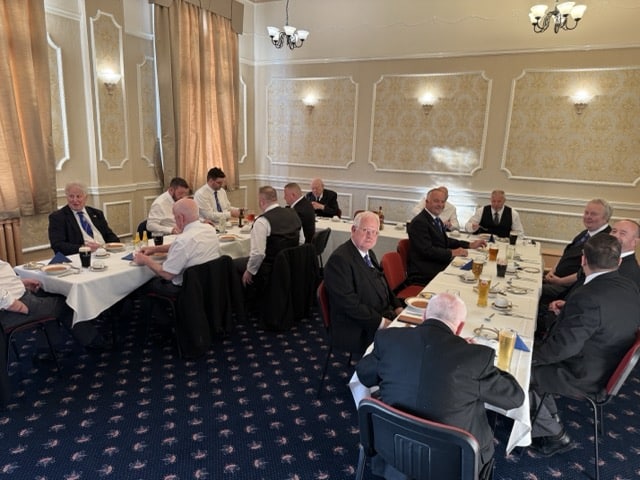
On 27 May 2026 the Eastern Area Team, headed up by Chairman WBro Andy Halford paid an informal visit to Roch Valley Lodge 5210.
The Area Team was made to feel very welcome along with other visitors and a visiting group from Crompton Lodge 8879 nicknamed ‘The Crompton Crew’.
The lodge meeting was opened in exemplary fashion and all those in attendance was given a lecture entitled “The Craft Under Threat: Freemasonry in Times of Persecution” which was researched and written by the Worshipful Master, WBro Andrew M Stott PProvAGDC.
Tonight, I invite you to join me on a journey through some of the darker chapters of our history – chapters that reveal not only the dangers the Craft has faced, but also the extraordinary resilience of the principles we uphold.
In previous lectures, we explored the colourful life of Casanova, a man whose Masonic experiences reflected the intellectual ferment of the Enlightenment, and we examined the dramatic events surrounding the Nazi raid on the lodge in Jersey during the Occupation. Those stories, though very different, share a common thread: they show how Freemasonry has repeatedly found itself at the crossroads of culture, politics, and power.
This evening, I want to broaden the lens. Instead of focusing on a single figure or a single event, we will consider a wider question: Why has Freemasonry so often been feared, suppressed, or persecuted – and what does that tell us about the Craft itself?
1. Why Freemasonry Attracts Suspicion
To understand persecution, we must first understand fear. And to understand fear, we must understand what Freemasonry represents.From its earliest days, the Craft has embodied ideas that were, in many societies, profoundly unsettling:
• We meet in private, beyond the reach of church or state.
• We elect our leaders by ballot, not by birth or decree.
• We insist that a man’s character matters more than his class, his wealth, or his lineage.
• We encourage free thought, moral autonomy, and the pursuit of truth.
• And we form bonds of brotherhood that cross borders, languages, and creeds.To us, these are virtues. To authoritarian minds, they are threats.
The history of anti-Masonic persecution is, in many ways, the history of those who fear independent thought, voluntary association, and the dignity of the individual.
2. Early Persecutions: Church and State
The first major institutional attack on Freemasonry came in 1738, when Pope Clement Xil issued the bull In Eminenti. His concerns were revealing: he objected to the secrecy of our meetings, the mixing of men of different social classes, and the possibility that Masons might form Loyalties not mediated by the Church.In Catholic Europe, the consequences were severe. Lodges were raided, brethren arrested, and in some cases tortured. In Portugal, the Inquisition pursued Masons with particular zeal. In parts of Italy and Spain, membership could lead to imprisonment or exile.
At the same time, in the German states, a different fear took hold: the fear of subversion. The brief and rather theatrical episode of the Bavarian Illuminati- a small, rationalist society that infiltrated some lodges – sparked a moral panic that still echoes today. Governments, already wary of private associations, seized upon the Illuminati as proof that Freemasonry was a political conspiracy.
Even across the Atlantic, in the young United States, the Morgan Affair of 1826 — in which a man who threatened to publish Masonic rituals disappeared under mysterious circumstances – led to the formation of the Anti-Masonic Party, the first third party in American politics. For nearly a decade, Freemasonry was treated as a national menace.
These early episodes set a pattern: whenever society was anxious, divided, or searching for scapegoats, Freemasonry became an easy target.
3. Totalitarianism and the Destruction of the Craft
The most brutal persecutions, however, came in the twentieth century, under regimes that sought absolute control over the individual.Nazi Germany
Hitler believed that Freemasonry was part of a supposed “Jewish world conspiracy”. This was not a fringe view: it was official doctrine. Lodges were closed, property seized, and members interrogated. Masonic archives were used to identify brethren, many of whom were arrested as political enemies.In the concentration camps, Masons were often classified under the red inverted triangle reserved for political prisoners. Some perished for no greater crime than their membership in the Craft.
Fascist Italy
Mussolini banned Freemasonry in 1925. The regime confiscated lodge buildings, arrested leaders, and portrayed the Craft as an enemy of the state. The Italian Grand Orient was forced underground, surviving only through the courage of brethren who risked everything to preserve their traditions.Franco’s Spain
Perhaps the most obsessive anti-Masonic regime of all was Franco’s Spain. In 1940, the dictatorship passed the “Law for the Repression of Freemasonry and Communism”, which treated both as treason. Masons were tried in military courts, imprisoned, and in some cases executed. Franco himself blamed Freemasonry for everything from the fall of the Spanish Empire to the outbreak of the Civil War.The Soviet Bloc
In the communist world, Freemasonry was condemned as bourgeois, elitist, and incompatible with Marxist ideology. Lodges were dissolved, and brethren were forced to abandon their meetings or continue in secret. In some countries, the Craft did not re-emerge until the fall of the Berlin Wall.Across these regimes, the pattern is unmistakable: authoritarianism cannot tolerate independent thought, private association, or moral autonomy – and Freemasonry embodies all three.
4. The British Isles in Wartime
Closer to home, the Second World War presented its own challenges.On the mainland, lodges continued to meet, though often under difficult conditions. Blackout restrictions, air raids, and the absence of brethren serving in the forces all took their toll. Yet the Craft remained active in charity, supporting bombed-out families, hospitals, and civil defense efforts.
In the Channel Islands, the situation was far more perilous. As we explored in a previous lecture, the Nazi occupation of Jersey led to the raid on the lodge, the seizure of records, and the interrogation of brethren. The contrast with Guernsey — where Masonic documents were hidden more successfully — highlights the courage and quick thinking required to preserve the identity of the Craft under occupation.
These stories remind us that persecution is not merely a distant or foreign phenomenon. It has touched our own shores.
5. Why Authoritarian Regimes Fear Freemasonry
At this point, we might ask: what is it about Freemasonry that provokes such hostility?The answer, I believe, lies in the values we uphold.
• We teach men to think for themselves.
• We encourage them to question, to reflect, and to seek truth.
• We promote equality, tolerance, and the brotherhood of all humanity.
• We form networks of mutual support that exist outside the control of the state.
• And we insist that moral authority comes not from coercion, but from character.To a tyrant, these are dangerous ideas.
Freemasonry does not seek political power. But it does cultivate independent minds – and independent minds are the natural enemies of tyranny.
6. The Craft’s Enduring Resilience
And yet, despite all these persecutions, Freemasonry has survived.It survived the Inquisition.
It survived the dictatorships of the twentieth century.
It survived war, occupation, and exile.
It survived because its principles are stronger than the forces that oppose them.Where regimes have fallen, lodges have reopened.
Where archives were seized, new records have been created.
Where brethren were scattered, new bonds have been forged.The Craft endures not because it is secret, but because it is meaningful.
Not because it hides, but because it stands for something worth preserving.7. Closing Reflection
Brethren, the history of persecution is not merely a catalogue of suffering. It is a testament to the strength of our ideals.When we open a lodge, when we welcome a candidate, when we speak the familiar words of our ritual, we participate in a tradition that has survived every attempt to silence it.
And so I leave you with this thought:
Freemasonry has outlived kings, popes, dictators, and demagogues — not through force, but through fidelity to the simple, profound principles of brotherly love, relief, and truth.May we continue to uphold those principles with the same courage as the brethren who came before us.
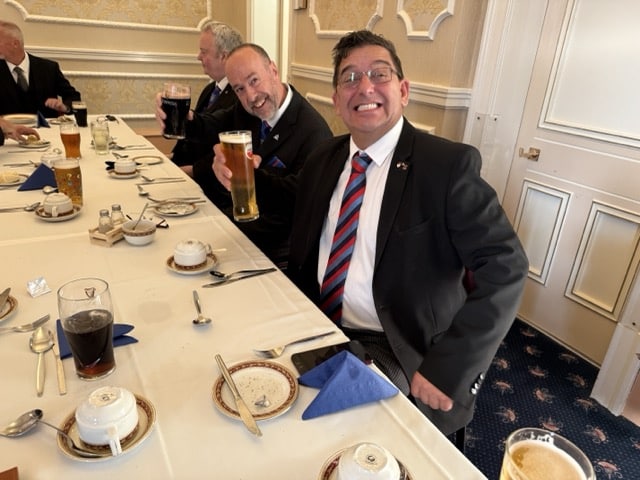
The brethren retired to a friendly social board enjoyed by all. To our next merry meeting.